restaurant marketing, one bite at a time.
Our Menu of
Marketing Tools For Restaurants.
No Marketing Degree Required


a la cart
Voice AI
Answers every call instantly—taking orders, booking reservations, and handling customer questions 24/7.
Social Posting Calendar
Post to socials from one platform! Facebook, Instagram, LinkedIn, TikTok, Pinterest, Google Business Profile, YouTube, Threads, and Bluesky.
$24.99/month
Google Review Response AI Agent
Have your AI agent respond to your Google Business Profile reviews with your response tone and style.
$29.99/month + AI response replies
Email Marketing
Upload your contact list to send email campaigns on your schedule.
$19.99/month + email sends
Website Builder
Choose from hundreds of templates to design your perfect website. Includes hosting and SSL certificate.
$29.99/month
Specials
All-in-one CRM
Handle all your restaurant's marketing needs from one platform.
Voice AI for Restaurants in 2026: Comparing Loman, Maple, Revmo, and Kea AI
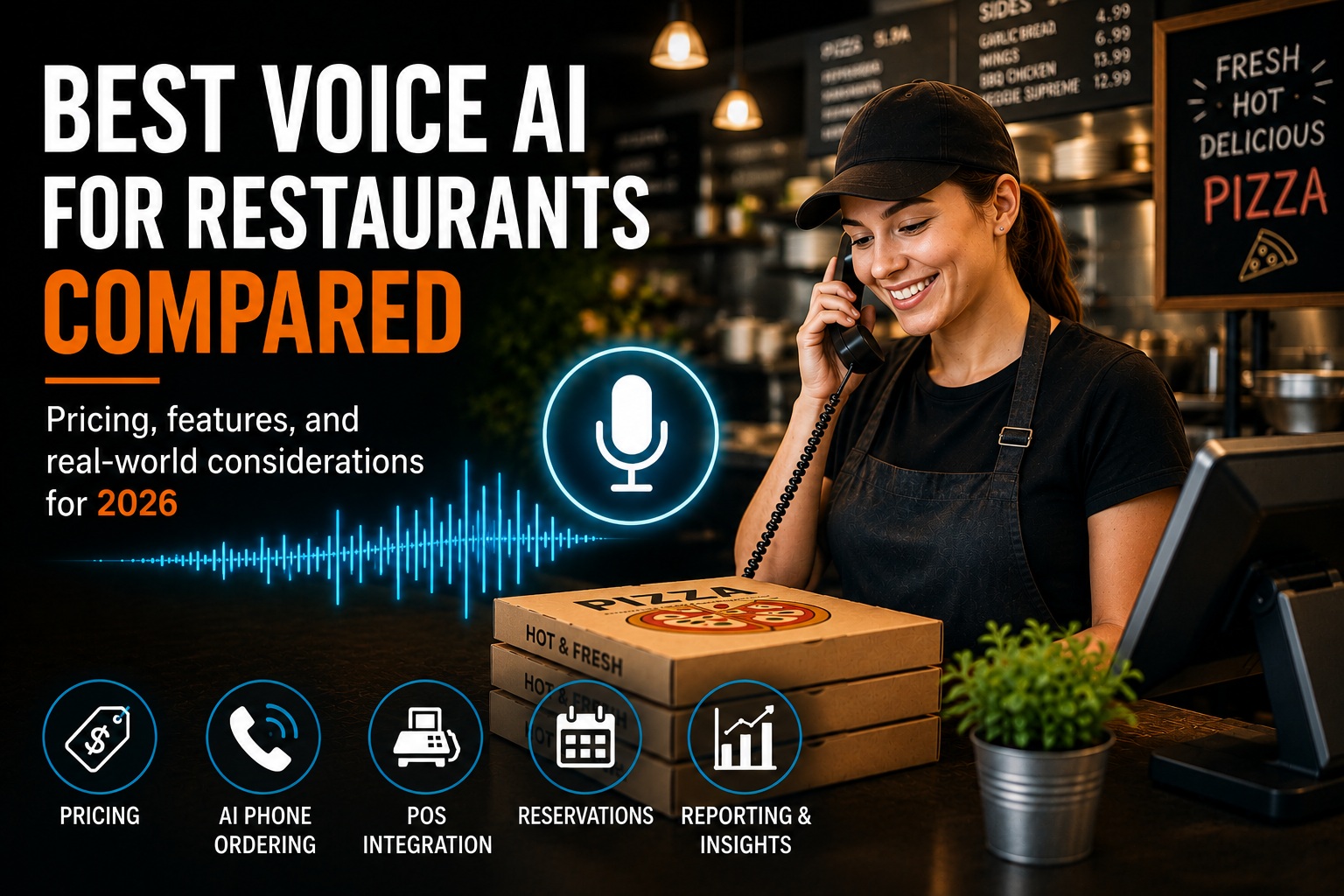
Voice AI for Restaurants in 2026: Comparing Loman, Maple, Revmo, and Kea AI
What To Look For In A Voice AI System
How to Evaluate Vendors Yourself
A Real-World Test: Friday Night Rush
What's the cheapest voice AI option for restaurants?
Do any of these systems have per-minute or overage fees?
Which of these integrates with the most POS systems?
Can these systems handle reservations, not just orders?
Last verified: June 2, 2026. Independently researched, not sponsored by, or compensated by any vendor listed below.
If you've ever watched the phone ring nonstop during a dinner rush while your staff is helping guests, taking orders, and running food, you already understand the problem voice AI is designed to solve. Every missed call could be a missed order, reservation, or customer who decides to call somewhere else.
Over the past few years, AI phone-answering and ordering systems built specifically for restaurants have evolved from a novelty into a legitimate technology category. Today, several vendors offer restaurant-focused voice AI solutions designed to answer calls, take orders, manage reservations, and reduce pressure on front-of-house staff. This comparison reviews four restaurant voice AI platforms in 2026, including pricing, POS integrations, reservations, ordering capabilities, and key considerations to review before choosing a provider.
This guide compares four of them, Loman, Maple, Revmo, and Kea AI, on pricing, features, POS integrations, and what to verify before signing a contract. It's built from each company's own published pricing and product pages, not from placing test calls, so it won't tell you how natural any of these sound on the phone. For that, request a live demo or trial from the vendors you shortlist. Every one of them offers one.
A note on the numbers: voice AI companies publish a lot of self-reported statistics (order accuracy rates, revenue lift percentages, call volumes). Where those appear below, they're labeled as vendor-reported because none of them have been independently audited. Treat them as a starting point for questions to ask, not as guaranteed outcomes for your restaurant.
Who This Guide Is For
This guide is designed for:
Independent restaurants
Pizza shops
Quick-service restaurants
Fast-casual concepts
Small and multi-location restaurant groups
If you're evaluating voice AI to answer calls, take orders, handle reservations, or reduce pressure on your staff, this comparison will help you understand how four of the most talked-about restaurant-focused platforms compare.
What To Look For In A Voice AI System
Before comparing specific vendors, it helps to know what actually separates a good system from a mediocre one. Regardless of which company you're evaluating, look closely at:
Keep this list in mind as you read the vendor breakdowns and ask each company directly how they handle each one for your specific menu and POS.
At A Glance
Pricing shown is for each vendor's standard, ordering-capable plan, billed monthly with no annual discount applied. "Vendor-stated" figures (setup time, concurrency, accuracy) come from the company's own marketing and have not been independently verified.
Scroll on mobile ➜
Loman
Loman is based in Austin, Texas, with a particular focus on independent and small multi-unit restaurants, including pizza concepts. EuroGyro, Little Italy Pizzeria & Pasta, Big Apple Pizza & Pasta, and Midland Pizza Co. has been named as a customer.
Pricing:
Starter: $199/month + $149 setup fee. Call answering, FAQs, and basic functions, with no ordering. Capped at 50 simultaneous calls per Loman's own pricing page.
Premium: $399/month + $149 setup fee. Adds full ordering, reservations, phone payments, complete POS integration, and an upsell engine.
Enterprise: Custom pricing for larger groups.
Core features (vendor-stated):
POS integrations: Toast, SpotOn, Clover, Shift4, Square, Aloha (NCR), Olo, and Stream
Reservations via OpenTable
Built-in upselling during order-taking
Live dashboard for calls, transcripts, and orders
Per-store menu overrides for multi-location brands
Self-reported 99.6% order accuracy and AI trained on 2M+ restaurant calls
Things to verify before signing: Loman's marketing describes "unlimited simultaneous calls," but its own published pricing page caps the Starter plan at 50 concurrent calls. It's worth clarifying directly which limit applies to the plan you'd actually be on, especially if you expect high call volume during rushes.
Also confirm current per-minute or overage terms directly, since published pricing states no per-minute fees, while some customer reports describe overage charges.
Maple
Maple positions itself as a phone-first system built for independent restaurants and small to mid-sized chains (roughly 1 to 50 locations, according to its own materials). Chick-fil-A, Quizno's, Crafty Crab Seafood, Laventina's Big Cheese Pizza, and Kissaki has been named as a customer.
Pricing:
Maple Voice: $150/month. Phone answering and FAQ handling only, with no ordering or reservations.
Maple Pro: $350/month. Adds phone ordering into your POS, OpenTable reservations, upselling, phone payments, and order-confirmation texts.
Maple Enterprise: Custom pricing for multi-location groups, with dedicated support and custom integrations.
A note on pricing accuracy: The above pricing is for Maple's month-to-month plans. They offer annual pricing discounts as well as affiliate discounts (code: NMA.
Core features (vendor-stated):
One of the broader POS integration lists among the four: Toast, Square, Clover, Lightspeed, LINGA, Aloha (NCR), NCR Voyix, Oracle MICROS, OrderCounter, Quantic, SkyTab, Smile, SpotOn, Stream, and TRAY
Reservations via OpenTable
Delivery integration via Chowbus
Intelligent upselling and order-confirmation texts (Pro tier)
Revmo
Revmo, based in Phoenix, serves restaurants alongside other verticals including automotive and home services. Donatos Pizza and Land Ocean New American Grill has been named as a customer.
Pricing:
Revmo uses a usage-based pricing model rather than a flat monthly fee.
Pilot: $0.59 per resolved conversation, plus a platform or agent fee starting around $79 per agent per month, for a single location. This tier is intended to help restaurants test the system using real call volume.
Scale: Custom pricing with committed usage, a contract term, multiple locations, and usage pooled across locations.
Enterprise: Custom multi-year pricing for larger restaurant portfolios, with additional security and compliance features such as SOC 2, PCI, HIPAA, and SSO.
Note that Revmo does not publish a flat monthly rate beyond the single-location Pilot tier. Multi-location pricing requires a custom quote.
Core features (vendor-stated):
Integrations: Toast, Olo, and Square for POS/ordering; OpenTable, SevenRooms, and Resy for reservations; TripleSeat for events/catering; major loyalty platforms; API access for systems not natively supported
Usage pools across multiple locations on the Scale and Enterprise plans, rather than billing per location independently
A pre-sales "AI Audit" process where Revmo reviews a sample of your actual call recordings before quoting a price
Things to verify before signing: Because pricing is usage-based and largely custom quoted, get a clear written estimate based on your actual historical call volume before committing. Costs can be more difficult to predict than with flat-rate competitors. Also ask directly about concurrent call handling and order accuracy, since neither figure is published on Revmo's pricing page or homepage.
Kea AI
Kea is one of the more established names in this category and has previously been used by Papa John's franchisees, Curry Up Now, Hop Doddy Burger Bar, Donatos Pizza, and Primanti Bros, among others.
Pricing:
Kea charges a flat rate of $450 per month. The company advertises this pricing as fully inclusive, with no per-order fees and no setup fee mentioned on its pricing page. Multi-location and franchise pricing is available by contacting Kea directly.
Core features (vendor-stated):
Direct POS order submission with integrations that including Toast, Square, Clover, and Olo. Also works with loyalty program, Thanx.
Unlimited concurrent calls
86'd-item detection and substitution handling
Reservation and waitlist handling via SMS
Spam call filtering
A companion text-ordering feature (SMS-based ordering, not just confirmations)
Self-reported 99.3% order accuracy
Things to verify before signing: Ask for the full list of supported POS systems if yours is not one of the four publicly listed integrations. Also ask specifically how reservations are handled, since Kea's own materials describe the feature as SMS and waitlist based rather than full AI-driven phone booking.
How to Evaluate Vendors Yourself
Published pricing pages and feature lists are a starting point, not a substitute for testing the system on your own menu and call patterns. Before signing a contract with any voice AI vendor:
Request a live trial or demo using your actual menu, including your most complicated items such as multi-modifier builds, allergens, and substitutions.
Ask for references from restaurants similar to yours in cuisine, order complexity, and call volume, not just their flagship case study.
Get concurrency limits in writing for the specific plan you'd be on, not just what's stated in general marketing copy.
Clarify the full pricing structure, including setup fees, overage terms (if any), and what happens if your call volume spikes during holidays or promotions.
Ask how order accuracy is measured and over what sample size. A vendor-reported "99% accuracy" figure means little without knowing the testing methodology behind it.
Confirm POS compatibility for your exact system and version, not just the brand name. Integration depth can vary even within the same POS platform.
A Real-World Test: Friday Night Rush
Imagine your restaurant receives dozens of calls between 5 PM and 7 PM on a busy Friday night. When evaluating a voice AI provider, ask:
How many calls can the system handle at the same time?
What happens if multiple customers call simultaneously?
Can it manage complicated orders with multiple modifiers?
How quickly do orders appear in the POS?
What happens if a customer wants to speak with a staff member?
The answers to these questions often reveal more than a feature list or marketing brochure. A vendor may have an impressive list of integrations and features, but the real test is how well the system performs during your busiest hours using your actual menu and call volume.
Frequently Asked Questions
What's the cheapest voice AI option for restaurants?
Among plans that include actual phone ordering, not just call answering, Maple's Pro plan at $350 per month is the lowest published flat rate among the four vendors compared here. Revmo's usage-based pricing could be cheaper at very low call volumes, but it isn't directly comparable to a flat monthly rate.
Do any of these systems have per-minute or overage fees?
Loman, Maple, and Kea all publish flat monthly pricing without per-minute fees. Revmo's pricing is explicitly usage-based, with a per-conversation fee plus an agent fee. Some third-party sources mention possible overage situations for specific vendors. Confirm current terms directly before signing, since published terms and customer-reported terms don't always match.
Which of these integrates with the most POS systems?
Based on each company's published integration lists, Maple currently lists the broadest range of named POS systems, followed by Loman. Kea and Revmo publish shorter named lists but mention API access or additional integrations available on request.
Can these systems handle reservations, not just orders?
Yes. All four offer some form of reservation handling. Kea uses SMS and waitlist functionality, while Loman, Maple, and Revmo integrate with OpenTable. Revmo also supports SevenRooms and Resy.
How accurate are these systems at taking orders correctly?
Several vendors publish high self-reported accuracy figures, generally in the high 90 percent range. However, none of the figures gathered for this guide include published third-party audits or disclosed testing methodology. The most reliable way to evaluate accuracy is to test the system yourself using your own menu before committing.
Final Thoughts
Voice AI has evolved from a novelty into a practical tool for many restaurants. The right system can help capture more orders, reduce pressure on staff, answer routine customer questions, and provide coverage during busy periods when employees simply can't get to every call.
No single platform is the best fit for every restaurant. A pizza shop handling hundreds of phone orders each week may have different priorities than a full-service restaurant focused on reservations and guest inquiries.
The best approach is to narrow your list to two or three vendors, schedule live demos, and test them using your actual menu and call scenarios. A short trial will often tell you far more than any feature comparison ever could.
Pricing, features, and integrations for all companies listed may change. The information above reflects each vendor's publicly available pricing and product pages as of the verification date noted at the top of this article. Confirm current details directly with each vendor before making a purchasing decision.

Who's This Perfect For
BUSINESS OWNERS
AGENCIES
CREATORS
INFLUENCERS
COACHES
TRAINERS
YOUTUBERS
SAASPRENEURS
AFFILIATES

restaurant marketing, one bite at a time.
Terms of Use | Privacy Policy | Accessibility | This Site Contains Affiliate Links
© 2026 Small Bites Restaurant, LLC | All Rights Reserved.