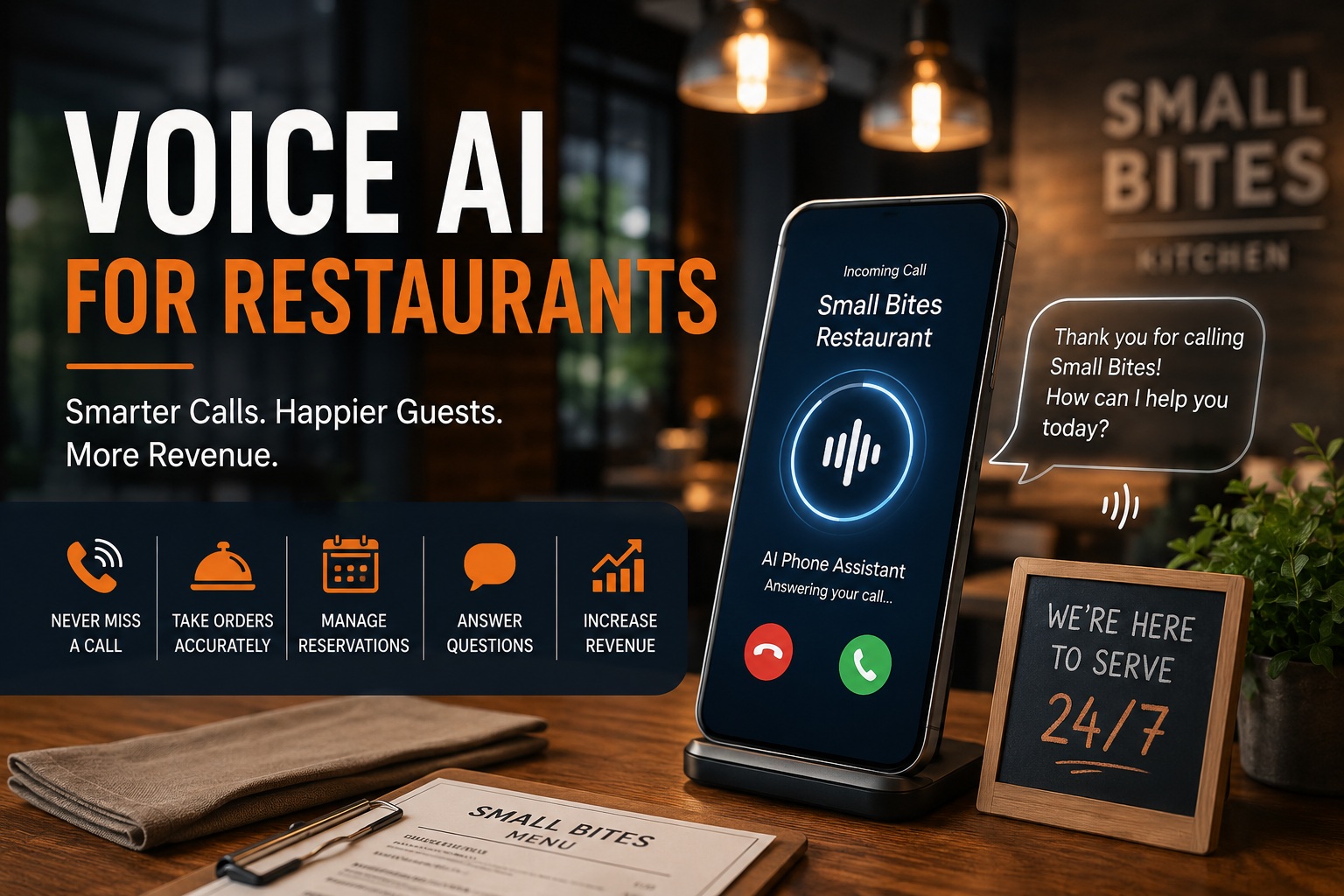
Voice AI for Restaurants: Why It's a Smart Investment for Owners
Running a restaurant is a constant balancing act. While you're managing the kitchen, helping guests, handling staffing issues, and keeping service moving, the phone keeps ringing. During a busy lunch or dinner rush, answering every call simply isn't realistic. The problem is that every missed call could be a lost order, reservation, or future customer. That's where voice AI for restaurants comes in.
Voice AI uses natural-sounding artificial intelligence to answer phone calls, take orders, manage reservations, and answer common customer questions, all without a staff member picking up the phone. For restaurant owners deciding where to invest next, it's quickly becoming one of the most practical and cost-effective technology solutions available.
What Is Voice AI for Restaurants?
Voice AI is a software system that listens to and responds to phone calls using natural language processing, much like a real host or order-taker would. Instead of a busy signal, a hold queue, or an employee trying to juggle a phone call while helping guests, the AI handles the conversation directly. It can confirm menu items, share specials, book reservations, and answer common questions about hours, parking, and location details.
Modern systems integrate with point-of-sale (POS) platforms, reservation software, and even loyalty programs. The call doesn't just get answered. It gets acted on.
Key Benefits of Voice AI for Restaurants
1. Never Miss a Call (or an Order)
Most restaurant owners already know the reality: when the dining room is busy, phone calls often go unanswered. Voice AI answers every call immediately, 24 hours a day, helping capture orders, reservations, and customer inquiries that might otherwise be missed during peak hours or after closing.
2. Order Accuracy and Consistency
Misheard orders, rushed notes, and distracted staff can lead to costly mistakes. A well-trained voice AI follows the same process every time, confirms items and modifications with the customer, and helps reduce errors that result in refunds, remakes, or negative reviews.
3. 24/7 Availability Without 24/7 Staffing
Customers don't only call during business hours. A voice AI system can answer questions, take reservations, and process orders late at night or early in the morning, helping restaurants capture business that might otherwise go elsewhere.
4. Lower Labor Costs and Less Burnout
Answering phones pulls staff away from the floor or kitchen, especially in smaller restaurants without a dedicated host. Voice AI allows employees to focus on guests, service, and food quality instead of constantly rushing to answer a ringing phone. Over time, that can reduce pressure on your team, improve service on the floor, and help employees stay focused on the customers standing right in front of them.
5. A Better, More Consistent Customer Experience
A calm, clear voice that never sounds rushed or frustrated, even during a busy Friday night, can improve a customer's first impression of your restaurant. Many restaurant voice AI platforms also offer multilingual support, making it easier to serve a broader range of customers.
6. Useful Data and Insights
Every call becomes a valuable source of information. Owners can identify peak call times, common customer questions, frequently requested menu items, and call patterns that might otherwise go unnoticed. These insights can help guide staffing decisions, menu updates, and operational improvements.
Why It's a Smart Investment for Restaurant Owners
Restaurant margins are notoriously thin, which makes every investment decision important. The good news is that voice AI often delivers a clear return on investment for several reasons:
It helps turn missed opportunities into actual sales. Every answered call creates the possibility of a completed order or reservation that might otherwise have been lost.
It handles busy periods without requiring additional staff. A voice AI system can manage multiple calls simultaneously, something that's difficult for even the best team members during peak hours.
It reduces error-related costs. Fewer order mistakes can mean fewer refunds, fewer remakes, and happier customers.
The cost is predictable. Most AI phone answering services for restaurants operate on a monthly subscription model that is often far less expensive than adding another employee to answer phones.
It's more accessible than ever. Technology that was once available only to large restaurant chains is now affordable for independent restaurants and small multi-location groups.
When owners compare the monthly cost of a restaurant AI phone system against the value of recovered sales, reduced mistakes, and improved staff efficiency, the business case often becomes surprisingly straightforward.
Getting Started with Voice AI
If you're considering voice AI for your restaurant, here are a few factors worth evaluating:
POS and reservation system compatibility. Make sure the platform integrates with the tools you already use.
Customization. The system should be trained on your menu, hours, policies, and frequently asked questions.
Fallback options. Look for solutions that can transfer calls to a staff member when necessary.
Reporting and analytics. Choose a platform that provides clear visibility into call volume, outcomes, and customer interactions.
Many restaurants start by using voice AI for after-hours calls and reservations before expanding it into full order-taking and customer service.

Frequently Asked Questions
Is voice AI only useful for large restaurant chains?
No. Many voice AI platforms are designed specifically for independent restaurants and small restaurant groups, with affordable pricing and straightforward setup.
Will customers know they're talking to an AI?
Most modern systems sound natural and conversational. Some restaurants choose to disclose it at the beginning of the call, while others focus on creating the smoothest possible customer experience. In either case, accuracy and convenience are usually what matter most to callers.
Can voice AI handle complex orders or special requests?
Yes. Most platforms can manage order modifications, dietary restrictions, allergies, and special requests. If a situation falls outside the system's capabilities, calls can typically be transferred to a staff member.
How much does voice AI for restaurants typically cost?
Pricing varies by provider, features, and call volume. Most platforms use a monthly subscription model that is generally less expensive than hiring additional staff solely to answer phones.
Does voice AI replace staff entirely?
Not usually. Most restaurants use voice AI as a support tool that handles repetitive phone tasks, allowing employees to focus on guest service, food preparation, and in-person interactions.
The Bottom Line
Voice AI for restaurants isn't just another piece of technology. It's a practical solution to a challenge restaurant owners deal with every day: keeping up with phone calls while running the business. By helping capture more orders, reduce mistakes, and free up staff to focus on guests, voice AI can deliver measurable value from day one. For many restaurants, it's quickly becoming one of the easiest technology investments to justify.